Scaling SaaS Startups: How Ventureship Supports Growth With Playbooks and Tools
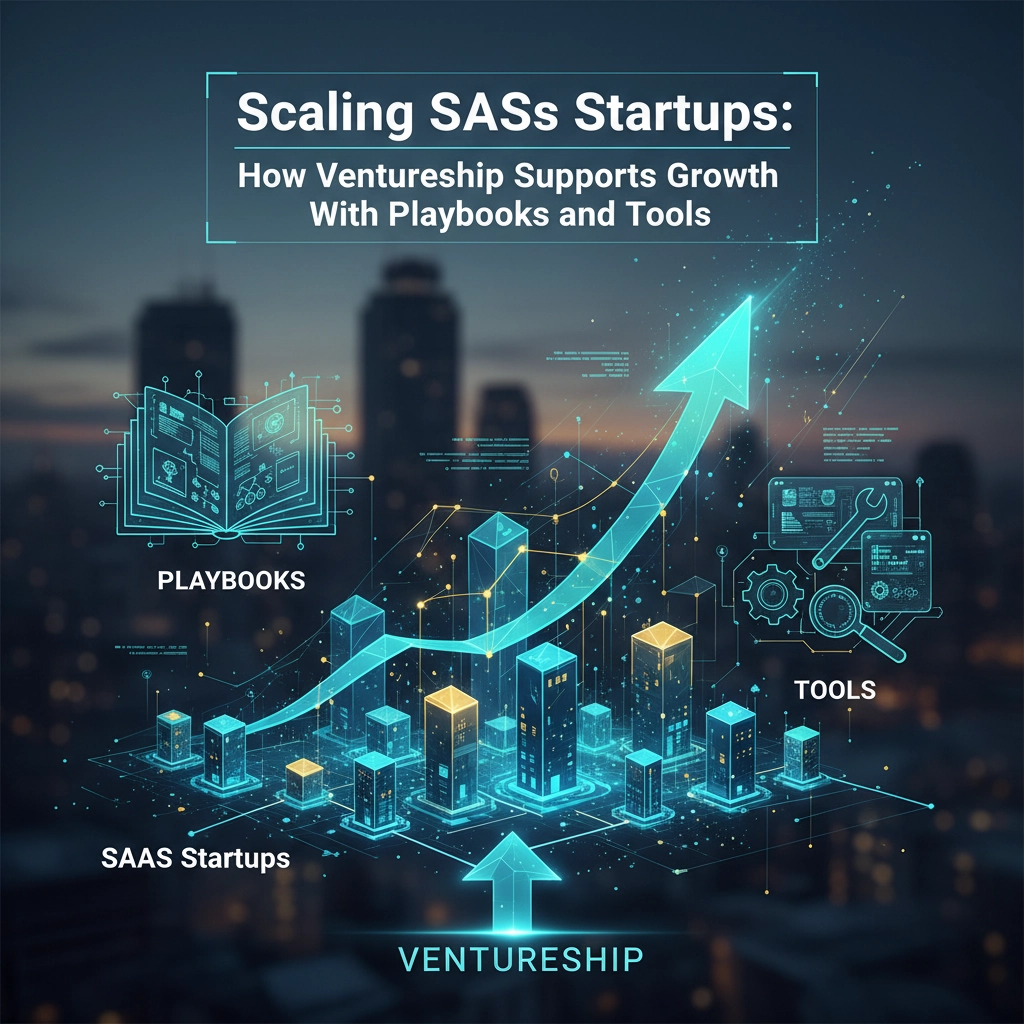
Scaling a SaaS startup isn't just about adding more servers or hiring more developers. It's about building repeatable systems that can handle 10x growth without breaking. That's where most founders hit a wall.
At Ventureship, we've seen this pattern play out hundreds of times. A scrappy startup finds product-market fit, gets some early traction, then suddenly everything feels chaotic. Customer support tickets pile up. Sales processes that worked for 10 customers fall apart at 100. The team that moved fast and broke things now needs structure.
This is exactly why we built our growth support system around proven playbooks and hands-on tools. Because scaling isn't a mystery: it's a skill that can be learned and systematized.
The SaaS Scaling Challenge
Most SaaS founders are technical people who excel at building products. But scaling requires a different skillset entirely. You need to think about customer success, sales operations, marketing automation, and team management all at once.
The typical scenario looks like this: A founder builds an amazing product, lands their first few customers through personal networks, then assumes they can just "do more of the same" to reach 100 or 1,000 customers. But the strategies that work at $10K MRR completely break down at $100K MRR.

We see founders trying to solve scaling challenges in isolation. They'll hire a VP of Sales without fixing their onboarding process. Or they'll invest heavily in marketing without having proper analytics in place. These piecemeal approaches rarely work because scaling requires systemic thinking.
That's why we developed our playbook methodology. Instead of leaving founders to figure it out alone, we give them battle-tested frameworks that have worked across dozens of successful companies.
Our Playbook Philosophy
A good playbook isn't just a document: it's a living system that guides decision-making. Our playbooks are built around three core principles:
Measurable outcomes first. Every playbook starts with clear success metrics. We don't just say "improve customer onboarding." We say "reduce time-to-first-value from 14 days to 7 days while maintaining 95% satisfaction scores."
Iterative implementation. Big changes fail. Our playbooks break complex transformations into weekly sprints with specific deliverables. This makes execution manageable and allows for course corrections.
Cross-functional alignment. Scaling problems are rarely isolated to one department. Our playbooks always consider how changes in one area impact other teams.
The Core Playbooks We Use
Customer Success Playbook
This covers the entire post-signup journey. We help founders map out every touchpoint from signup to renewal, identifying drop-off points and optimization opportunities.
The playbook includes templates for onboarding emails, success milestone tracking, and health score calculations. We also provide scripts for customer check-ins and expansion conversations.
One portfolio company used this playbook to reduce churn from 8% to 3% monthly while increasing average contract value by 40%. The key was implementing systematic touchpoints instead of hoping customers would figure things out themselves.

Sales Operations Playbook
Early-stage SaaS companies often treat sales like a black box. Someone talks to prospects, some percentage convert, and that's considered good enough. But you can't scale what you can't measure.
Our sales ops playbook helps founders build proper pipeline tracking, implement lead scoring, and create repeatable sales processes. We provide CRM setup guides, sales stage definitions, and forecasting templates.
The goal isn't to over-engineer sales: it's to create predictable revenue growth. When you know exactly how many leads you need to hit your targets, you can make smart decisions about marketing spend and sales hiring.
Product-Market Fit Validation
Even companies with early traction often haven't achieved true product-market fit. Our PMF playbook helps founders systematically test and validate their value proposition.
This includes customer interview frameworks, feature prioritization matrices, and retention analysis tools. We help founders distinguish between early adopters who'll tolerate a rough product and mainstream customers who need something polished.
One company we worked with thought they had PMF because they had paying customers. But our analysis revealed that 70% of users weren't getting value from the core feature. After refocusing the product, their retention improved dramatically.

Tools That Make the Difference
Playbooks provide the strategy, but tools enable execution. We've built a comprehensive toolkit that integrates with our playbooks to give founders everything they need.
Growth Metrics Dashboard
Most founders track vanity metrics like signups or page views. Our dashboard focuses on actionable metrics that actually predict growth: activation rates, time-to-value, expansion revenue, and cohort retention.
The dashboard pulls data from multiple sources: your app, payment processor, support system, and marketing tools: to give you a unified view of business health. More importantly, it highlights which metrics need attention right now.
Customer Journey Mapping Tool
This visual tool helps founders understand exactly how customers interact with their product. You can see where people get stuck, which features drive retention, and what triggers upgrades.
The tool integrates with analytics platforms but presents data in a way that's actually useful for decision-making. Instead of drowning in data, you get clear insights about what to fix first.
Resource Library and Templates
We maintain a library of proven templates: email sequences, sales scripts, customer surveys, pricing pages, and more. These aren't generic templates: they're battle-tested resources from successful portfolio companies.
Each template comes with implementation notes and customization guidelines. This saves founders weeks of work and gives them professional-grade materials from day one.

The Community Advantage
Tools and playbooks are valuable, but peer learning accelerates growth like nothing else. That's why we've built a strong community of portfolio founders who share experiences and solve problems together.
Our monthly scaling sessions bring together founders facing similar challenges. A company dealing with customer churn can learn from someone who just solved that exact problem. An entrepreneur struggling with pricing strategy can get advice from someone who recently nailed their pricing model.
This peer-to-peer learning is incredibly valuable because the advice comes from people who are actually in the trenches. They understand the constraints and pressures that founders face.
We also facilitate smaller working groups focused on specific challenges: international expansion, enterprise sales, product-led growth, and more. These intimate sessions allow for deeper problem-solving and relationship building.
Measuring Success
The proof is in the results. Companies using our playbook and tool system achieve measurable improvements across key metrics:
- Faster time-to-revenue: Portfolio companies reach $1M ARR 40% faster on average
- Higher retention: Monthly churn rates improve by an average of 50%
- Better unit economics: CAC payback periods decrease by 30-60 days
- Smoother scaling: Revenue per employee increases as teams grow
These aren't overnight transformations. Most improvements happen over 6-12 months of consistent implementation. But the results compound over time, creating sustainable competitive advantages.

One portfolio company grew from $100K to $2M ARR in 18 months using our customer success and sales ops playbooks. They didn't reinvent the wheel: they just implemented proven systems consistently.
The Path Forward
Scaling a SaaS startup doesn't have to be chaotic. With the right playbooks, tools, and community support, founders can build predictable growth systems that work at every stage.
The key is starting early. Don't wait until you're overwhelmed to implement proper processes. The companies that scale most successfully are the ones that build good systems when they're still small.
If you're a SaaS founder ready to scale systematically, we'd love to help. Our playbooks and tools have helped dozens of companies navigate the challenges of growth, and we're always refining our approach based on real-world results.
Because at the end of the day, scaling isn't about working harder: it's about working smarter with proven systems that compound over time.