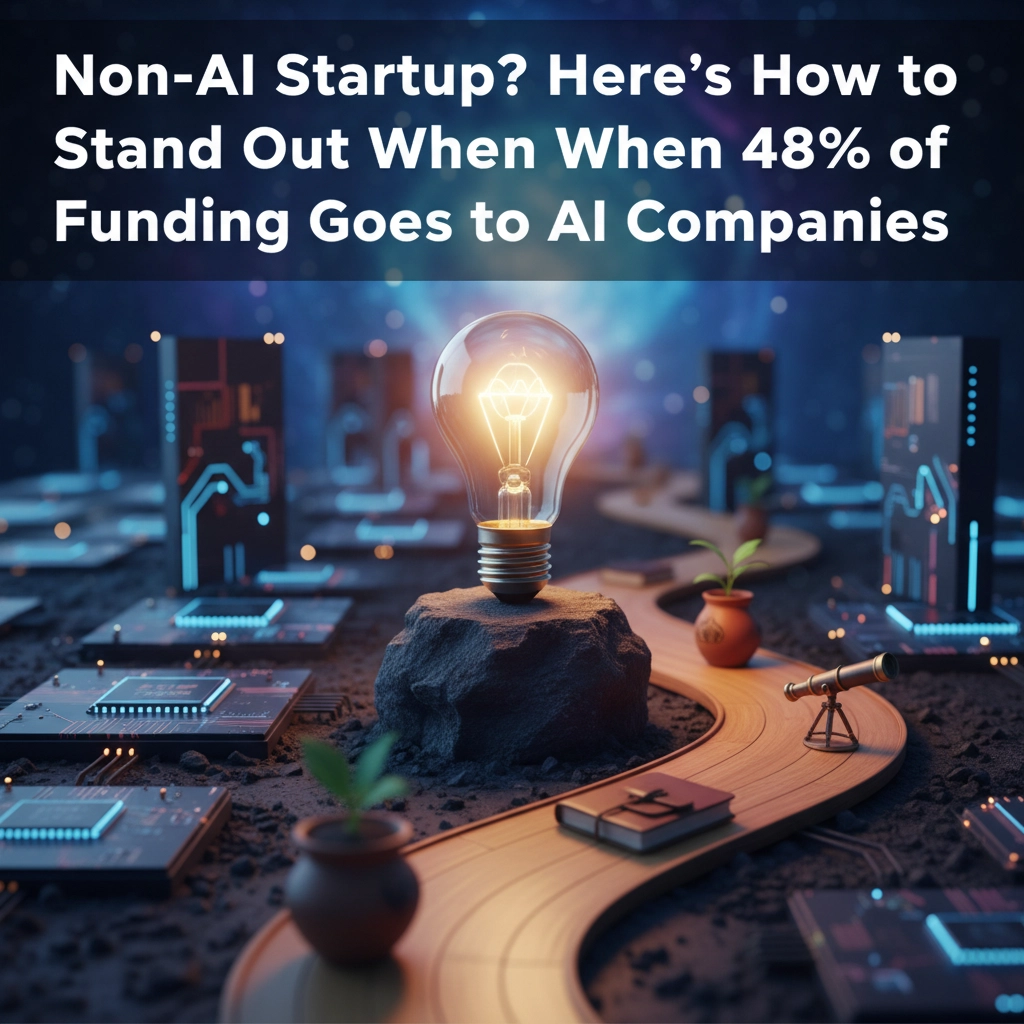
Non-AI Startup? Here's How to Stand Out When 48% of Funding Goes to AI Companies
The funding reality is even more stark than you might think. While your headline mentions 48% of funding going to AI companies, recent data reveals that AI startups actually captured 62.7% of US venture capital in Q3 2024, and 53.2% of global VC funding. The market has become what investors call "bifurcated" – you're either building AI or you're not, and that distinction increasingly determines your access to capital.
This isn't just a temporary trend. The venture landscape has contracted dramatically, with only 823 venture funds raised globally in 2024 compared to 4,430 funds launched in 2022. For non-AI founders, this means you're competing for a shrinking pool of capital against an AI hype cycle that shows no signs of slowing.
But here's the thing – this challenge is also your opportunity. While everyone else chases AI dollars, smart non-AI startups are quietly building sustainable, profitable businesses that solve real problems. The key is knowing how to position yourself strategically.
Master the Art of Strategic Storytelling
Traditional product announcements won't cut it anymore. Research shows that 60% of press releases focus solely on product updates, but VCs prioritize companies that demonstrate thought leadership and industry influence. Only 42% of press releases focus on original content like thought leadership articles, survey results, and educational resources – exactly the content that builds credibility with investors.
Investors want to see more than just technical capability. They're looking for industry authority, market longevity, and a clear vision for scalability. This means you need to consistently produce insights that shape industry conversations, publish research that others reference, and position your founders as subject matter experts whose perspectives matter beyond your specific product.
Start by identifying the three biggest industry trends that will impact your market over the next five years. Then become the go-to source for commentary on those trends. Write detailed analyses, conduct surveys, and share counterintuitive insights that challenge conventional thinking.
Position Yourself as Essential Infrastructure

Non-AI startups aren't alternatives to AI ventures – you're often the foundation they depend on. AI companies can't thrive without infrastructure like specialized chips, robust data pipelines, and efficient energy systems. If your startup operates in any of these supporting sectors, emphasize how you're creating the conditions that allow AI companies to scale securely and efficiently.
Take the energy sector as an example. AI training requires massive computational power, which demands enormous energy resources. A startup building more efficient data center cooling systems or renewable energy solutions isn't competing with AI – it's enabling AI at scale while solving critical infrastructure challenges.
The same principle applies across industries. Logistics startups optimize supply chains that AI companies depend on. Manufacturing innovations create the physical components that power AI hardware. Financial infrastructure enables AI companies to operate and scale globally.
Frame your value proposition around enabling the broader ecosystem rather than competing within it.
Target Trillion-Dollar Markets AI Hasn't Conquered
While everyone pours resources into AI, entire trillion-dollar markets remain underserved. Commerce, logistics, manufacturing, and energy offer massive opportunities that AI hasn't effectively penetrated. Climate change, healthcare accessibility, supply chain resilience, and affordable housing will define the next decades.
These problems require more than algorithms – they need material science breakthroughs, clean energy innovations, regulatory solutions, and entirely new business models. Non-AI startups are often the ones willing to tackle these hard, less glamorous challenges that investors increasingly recognize as necessary.
Consider Whatnot, which built a thriving livestream shopping marketplace for collectibles by focusing on community-driven commerce rather than AI algorithms. Or Maisonette, which curates a marketplace for children's goods by emphasizing design, branding, and trust over technical novelty. Both prove that consumer experience and domain expertise can create massive value without AI at the core.
Demonstrate Superior Capital Efficiency
Here's a dirty secret about the current AI boom – burn multiples for AI companies have reached $5 burned to gain $1 of new revenue, suggesting that cheap capital might be fueling inefficient growth. This creates a massive opportunity for non-AI startups to differentiate through superior capital efficiency.
Show investors how your business model achieves sustainable growth without the profligate spending patterns becoming normalized in AI startups. Highlight metrics like customer acquisition cost, lifetime value ratios, and path to profitability. In a market where AI companies often prioritize growth over unit economics, demonstrating fiscal discipline becomes a competitive advantage.
Find Specialized Investors Who Get Your Space

The concentration of capital means that one-third of US VC investment now comes from deals with the six largest funds, driven almost exclusively by massive AI deals. This concentration creates opportunity – seek out specialized investors who understand your sector deeply rather than competing for attention from generalist mega-funds fixated on AI.
Research investors with proven track records in your specific industry. These investors are actively looking for portfolio diversification and may be underserved by current market dynamics. They understand the nuances of your business model, the regulatory environment you operate in, and the long-term value creation potential that generalist investors might miss.
Create a target list of 50 specialized investors rather than 500 generalist ones. Your conversion rate will be higher, and the investors who do engage will bring more relevant expertise and network connections.
Build Defensible Moats Through Deep Domain Expertise
While AI startups often compete on technical capabilities that can become commoditized, non-AI startups can build deeper, more defensible moats through specialized domain knowledge. This might include regulatory expertise, established supplier relationships, proprietary manufacturing processes, or deep customer insights that take years to develop.
Focus on becoming the definitive expert in your specific niche. Understand your customers' workflows better than anyone else. Build relationships with key industry players that would be difficult for newcomers to replicate. Develop intellectual property that's specific to your domain rather than broadly applicable technology.
Control Your Narrative Consistently
Startups that control their own narratives and consistently deliver thought leadership insights gain a competitive edge over those that rely solely on product announcements. This means maintaining a steady drumbeat of industry commentary, original research, and forward-looking perspectives that position your company as an inevitable player in your space.
Develop a content calendar that positions your expertise across multiple channels. Write detailed case studies showing how you've solved specific customer problems. Share contrarian perspectives on industry trends. Publish research that becomes referenced by others in your space.
The goal is to make it impossible for investors to think about your market without thinking about your company.
Timing Your Fundraising Strategically
The current market bifurcation won't last forever. Markets are cyclical, and the extreme focus on AI will eventually moderate as investors seek diversification and as AI returns begin to normalize. Position your startup to be ready when this shift occurs.
This means building strong fundamentals now – sustainable growth metrics, efficient operations, and clear paths to profitability. When the market corrects and investors start looking beyond AI for returns, you want to be the obvious choice in your category.
The current funding environment is challenging for non-AI startups, but it's not impossible. Success requires strategic thinking, superior execution, and patience. While others chase the latest AI trend, focus on building something sustainable that solves real problems for real customers. The investors and customers will follow.
Your advantage isn't competing with AI – it's being essential to the broader ecosystem that makes AI possible while solving problems that AI can't address alone.