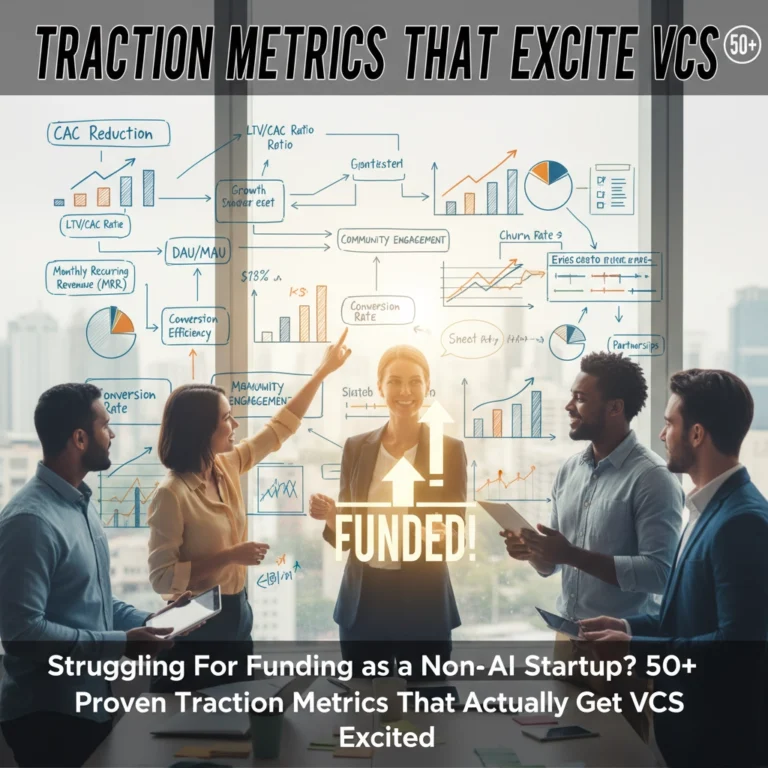
Struggling For Funding as a Non-AI Startup? 50+ Proven Traction Examples That Actually Get Investors' Attention
Let's be honest – if you're running a non-AI startup in 2025, you've probably felt like the overlooked kid at the school dance. Everyone's throwing money at AI companies while you're over here building something equally valuable, just not as flashy.
Here's the thing: investors are still funding non-AI startups. They're just looking for different signals than they did two years ago. The good news? Once you know what these signals are, you can engineer them into your business.
What Investors Actually Want to See (Spoiler: It's Not What You Think)
Forget everything you know about traditional traction metrics. In 2025, smart investors aren't just looking for hockey stick growth charts or impressive user counts. They want to see compounding signals – evidence that your business creates self-reinforcing loops that get stronger over time.

Here's what that looks like in practice:
Instead of saying: "We have 10,000 users"
Say this: "Every new user refers an average of 0.8 others within their first month"
Instead of saying: "We're growing 20% month-over-month"
Say this: "Our customer acquisition cost dropped from $47 to $23 while our retention improved from 60% to 78%"
These aren't just different ways of saying the same thing. They're fundamentally different types of proof that show your business is building momentum, not just adding numbers.
The 50+ Traction Examples That Actually Work
Product Usage & Engagement Signals
- Daily active user frequency: "73% of users open our app within 2 hours of receiving a notification"
- Feature adoption cascade: "Users who try Feature A have a 4x higher likelihood of adopting Feature B"
- Session depth progression: "Average session time increased from 3 minutes to 12 minutes over 90 days"
- Return visitor patterns: "Users who complete onboarding have an 89% week-2 retention rate"
- Usage habit formation: "After 7 days, 84% of users check our app before their email"
Network Effects & Viral Mechanics
- Organic referral rates: "42% of new signups come from existing user recommendations"
- Collaboration multipliers: "Teams that invite a second member see 3x higher engagement"
- Content sharing velocity: "User-generated content gets shared 2.3x more than our branded content"
- Community growth loops: "Each active community member brings in an average of 1.6 new members monthly"
- Cross-pollination metrics: "Users from Company A invite users from Companies B and C 67% of the time"

Revenue & Business Model Traction
- Customer lifetime value growth: "CLV increased 156% while acquisition costs stayed flat"
- Revenue per user expansion: "Average revenue per user grew from $23 to $67 through upsells"
- Payment conversion rates: "Free-to-paid conversion improved from 3% to 11% after UX changes"
- Contract value growth: "Average deal size increased 78% quarter-over-quarter"
- Revenue predictability: "91% of next month's revenue is already contracted"
Market Validation & Customer Behavior
- Organic search volume: "Branded search terms increased 340% in six months"
- Customer support metrics: "Support ticket volume decreased 45% while user base doubled"
- Feature request patterns: "Customer-requested features drive 67% of our development roadmap"
- Retention by cohort: "Our March cohort has 23% better retention than February's"
- Usage consistency: "68% of weekly active users use our product 4+ days per week"
Competitive & Market Position
- Market share capture: "We're processing 12% of all transactions in our category in Denver"
- Switching costs evidence: "Only 2.1% of paying customers churned to competitors last quarter"
- Price elasticity tests: "Demand remained stable through a 30% price increase"
- Integration stickiness: "Customers using our API have 94% renewal rates"
- Category creation: "We've been featured in 18 'best of' lists for our new category"
Team & Operational Excellence
- Hiring efficiency: "Engineering team productivity increased 45% after our recent hires"
- Process optimization: "Customer onboarding time decreased from 14 days to 3 days"
- Quality improvements: "Bug reports dropped 67% while feature velocity increased"
- Knowledge capture: "Internal documentation reduced training time by 60%"
- Decision speed: "Average feature decision time decreased from 3 weeks to 4 days"
Advanced Traction Signals That Separate Winners from Wannabes

Behavioral Change Evidence
- Workflow replacement: "87% of users stopped using their previous solution within 30 days"
- Daily habit integration: "Users check our platform before coffee 43% of the time"
- Decision-making changes: "Customers report making 2x faster decisions using our tool"
- Process transformation: "Teams using our solution complete projects 34% faster"
- Communication shifts: "Internal team messages decreased 28% while productivity metrics improved"
Economic Impact Metrics
- Cost savings documentation: "Customers save an average of $14,000 annually using our solution"
- Revenue impact for customers: "Clients using our platform see 23% revenue increases on average"
- Efficiency multipliers: "One hour using our tool saves customers 4.7 hours of manual work"
- Risk reduction: "Compliance issues decreased 89% for customers using our automated features"
- Time-to-value: "Customers see ROI within their first 21 days"
Strategic Partnership & Distribution
- Channel partner success: "Partners drive 34% of our new customer acquisition"
- Integration adoption: "68% of customers use our integrations within their first month"
- Ecosystem positioning: "We're the default choice for 3 major industry platforms"
- Referral program performance: "Referred customers have 2.4x higher LTV than direct signups"
- Partnership revenue: "Partner-driven revenue grows 23% faster than direct sales"
Future-Proofing Indicators
- Scalability evidence: "Infrastructure costs decreased per user as we scaled from 1K to 10K users"
- Learning velocity: "Product iteration cycle improved from 6 weeks to 10 days"
- Market expansion readiness: "Current customers are asking us to solve 3 adjacent problems"
- Technology moat building: "Our data advantage improves predictions by 12% every quarter"
- Talent magnet effect: "We're recruiting competitors' top talent without increasing comp packages"
When Traditional Traction Isn't Possible
Not every startup can show perfect metrics from day one. If you're in an early stage or facing unique challenges, focus on these alternative approaches:
The Dream Team Approach: When you don't have traction yet, pitch why your specific team is uniquely positioned to solve this problem. Highlight relevant experience, domain expertise, and complementary skills that competitors can't replicate.
Market Timing Evidence: Show that external factors are creating a perfect storm for your solution. Industry shifts, regulatory changes, or technological enablers can be more compelling than early usage metrics.
Pilot Success Stories: Even if you can't share full metrics, detailed case studies showing clear before-and-after scenarios with pilot customers can be incredibly powerful.

Alternative Funding Paths When Investor Interest Is Low
Revenue-Based Financing: Exchange a percentage of future revenues instead of equity. This can provide quick capital (often within weeks) with flexible repayment tied to your actual performance.
Grant Opportunities: SBIR and STTR programs provide billions in federal funding annually for research and development. State and local economic development grants can also provide non-dilutive capital.
Strategic Customer Funding: Some customers will pay upfront for custom development or guaranteed future access to your product. This validates demand while providing runway.
Making Your Traction Story Irresistible
The key isn't having perfect metrics – it's telling a compelling story about momentum and future potential. Focus on:
Compound Growth Loops: Show how each success creates conditions for bigger future successes
Behavioral Proof Points: Demonstrate that users won't go back to their old way of doing things
Market Position Building: Prove you're becoming harder to displace over time
Remember, investors are funding changes in behavior at scale, not just products or services. Your traction story should show clear evidence that you're creating lasting change in how people work, live, or make decisions.
The non-AI startup funding landscape might be competitive, but it's far from impossible. Armed with the right traction signals and a compelling story about compound growth, you can capture investor attention and secure the funding you need to scale.